For international students in South Korea, managing your legal status can sometimes be more challenging than your major exams. No matter how high your GPA is or how many friends you have made, failing to report simple changes to the government can lead to heavy fines—or worse—the rejection of your work visa after graduation.
Based on the January 2026 Immigration Manual, we have summarized the three most common reporting mistakes made by students and how to avoid them to protect your future career in Korea.
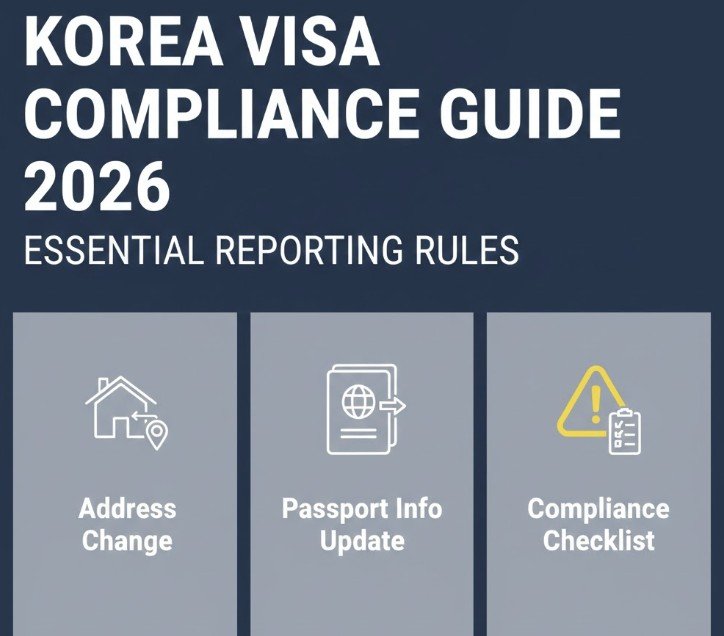
1. Change of Residence: The “14-Day Rule”
This is the most frequent cause of fines. Whether you are moving from a university dormitory to an “One-room” or moving in with a friend, you must report your new address.
- Reporting Deadline: Within 14 days of moving into the new residence. (Starting from the 15th day, it is considered a violation).
- How to Report:
- HiKorea (Recommended): If you have a digital certificate, you can complete this in 5 minutes online.
- Local Community Center (Jumin-center): Visiting a local office near your new home to file a “Transfer Report” (Jeonip-singo) will automatically sync with the immigration system.
- Pro-Tip: If the lease agreement is not in your name, you must additionally submit a “Confirmation of Residence/Accommodation” form signed by the house owner or the main tenant.
2. Changes in Passport Information: “Got a New Passport?”
If your passport expired and you received a new one, or if your passport number changed for any reason, you must inform the South Korean government. If the info on your Alien Registration Card (ARC) does not match your actual passport, system errors will occur during any visa process.
- What to Report: Passport number, issuance date, expiration date, name, gender, or nationality changes.
- Reporting Deadline: Within 15 days of the change.
- Real-Life Trap: If you received a new passport while visiting your home country, the 15-day countdown often starts from the issuance date of the new passport, not necessarily the date you returned to Korea. Be sure to report it immediately upon your return.
3. Changes in Academic Status: “Taking a Leave or Graduating?”
The Study (D-2) visa is granted on the premise that you are a full-time student. The moment your academic status changes, the validity of your visa is jeopardized.
- Reporting Duty: Your university is legally obligated to report changes such as Leave of Absence (Hyuhak), Withdrawal (Jatoe), Expulsion, Graduation, or Disappearance to the government.
- Stay Period Shortening: Once an academic change is reported, you must generally leave the country within 15 to 30 days, regardless of the expiration date printed on your ARC.
- Pro-Tip: If you wish to stay in Korea after taking a leave of absence, you must consult with the immigration office beforehand to see if a change of status is possible. Staying without a valid permit will make future re-entry extremely difficult.
⚠️ The True Cost of Negligence: Fines and Blacklists
Don’t think of it as just “paying a small fine.” According to December 2025 statistics, administrative fines due to reporting omissions account for a significant portion of all penalties issued to foreigners.
- Financial Loss: Fines range from hundreds of thousands to over 1 million KRW depending on the duration of the violation.
- Visa Rejection: When you apply to change to a Job Seeker (D-10) or Professional (E-7) visa after graduation, the government evaluates your “Law-Abiding Spirit.” A history of fines gives the immigration officer a valid reason to judge you as “unfit for compliance” and reject your application.
Conclusion: Successful Life Starts with Risk Management
A successful life in Korea begins with meticulous record-keeping. Save your passport expiration date in your phone calendar and remember your “Moving Day” as your “Reporting Day.”
By bookmarking HiKorea and checking your residency status once a month, you can ensure that your hard-earned visa remains safe. Remember, in the world of immigration, being “informed” is your best defense.
Official Sources & References
- Korea Immigration Service (MOJ): Guidelines for Reporting Changes in Residence and Registration, January 2026.
- Ministry of Justice: Management Manual for Students with Academic Status Changes, January 2026.
- Statistics Korea: Monthly Report on Administrative Penalties and Fines for Foreign Residents, December 2025.
- HiKorea Official Portal: E-Government Service Guide and Violation Case Studies (www.hikorea.go.kr).