Living in a Korean apartment offers unmatched convenience, but it comes with a monthly Maintenance Bill (Gwan-ri-bi). For many expats, this bill is just another expense to be paid. However, did you know that hidden within these monthly charges is a “hidden fund” that could amount to hundreds, or even over a million Korean Won, which you are legally entitled to get back when you move out?
Based on the March 2026 update of the Multi-Family Housing Management Act and real estate practical knowledge, here is how to deconstruct your maintenance bill and execute a strategic refund plan.
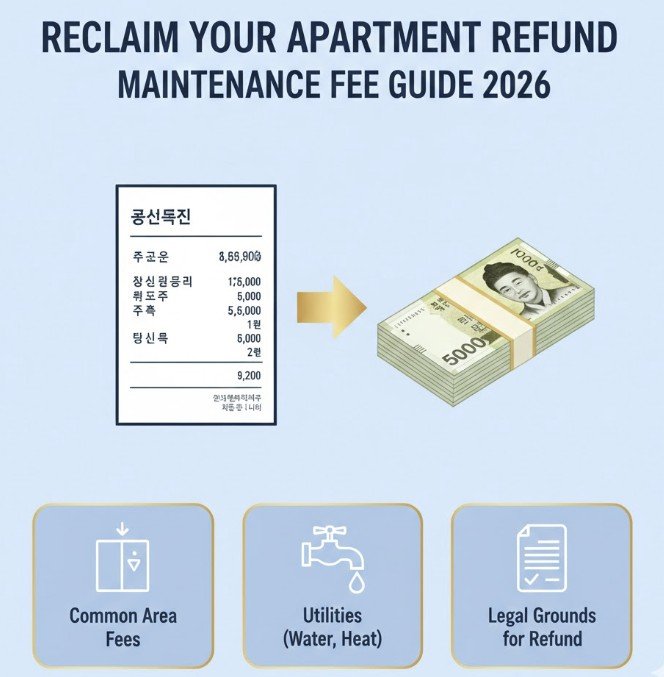
1. Anatomy of the Maintenance Bill: Key Items to Watch
Maintenance fees in Korea are divided into ‘Common Management Fees’ and ‘Individual Usage Fees.’ Here are the most critical items you will see on your statement:
| Item (Korean) | English Equivalent | Description |
| 일반관리비 | General Management | Staff salaries and office operation costs |
| 청소비/소독비 | Cleaning/Disinfection | Cleaning of common areas and pest control |
| 승강기유지비 | Elevator Maintenance | Inspection and repair costs for elevators |
| 전기료/수도료 | Electricity/Water | Based on your actual monthly consumption |
| 장기수선충당금 | Long-term Repair Fund | [CRITICAL] Fund for major structural repairs |
| 수선유지비 | Repair Maintenance Fee | Minor repairs like replacing light bulbs in hallways |
2. [Must-Read] The Refund Hero: Long-term Repair Fund
The Long-term Repair Fund (Jang-gi-su-seon-chung-dang-geum) is the most significant amount many global professionals overlook.
- What is it? It is a reserve fund collected to prepare for major renovations, such as replacing elevators or repainting the building’s exterior.
- Who is responsible? Legally, this cost must be borne by the Property Owner (Landlord). However, for administrative convenience, it is included in the monthly bill and paid by the tenant first.
- How to get it back?
- On your moving day, visit the Apartment Management Office (Gwan-ri-samu-so) and request a “Payment Confirmation of Long-term Repair Fund.”
- Check the total accumulated amount paid during your lease term. (Typically ₩10,000–₩300,000 per month; for a 2-year contract, this can reach ₩300,000–₩700,000).
- Claim this total amount from your landlord. While most landlords and realtors are aware of this, they may not offer it unless you ask. Demand it confidently.
3. Warning: “Repair Maintenance Fee” is NOT Refundable
Do not confuse the Long-term Repair Fund with the Repair Maintenance Fee (Su-seon-yu-ji-bi).
- The Repair Maintenance Fee covers consumable items and minor repairs needed while you are living there (e.g., cleaning heating systems or replacing shared light bulbs).
- This is considered a cost for the actual user (tenant) and is not refundable upon moving out. Knowing the difference will prevent unnecessary disputes with your landlord.
4. Settlement Checklist on Moving Day
Moving day is hectic. Follow these three steps to ensure a clean financial break:
- Mid-term Settlement (관리비 정산): Inform the management office of your electricity, water, and heating meter readings on the morning of your move. Pay the calculated “balance up to today” and show the receipt to the new tenant or the realtor.
- City Gas Settlement: Gas is often billed separately. Call your regional gas provider in advance, provide the meter reading, and pay the balance immediately via credit card or bank transfer.
- TV Subscription Fee: If you don’t own a TV but see a ₩2,500 fee on your bill, call KEPCO (123) in advance to cancel it and request a refund for past months.
5. Conclusion: You Only Get Back What You Know
In 2026, with the rising cost of living, managing maintenance fees is essential. Remember, part of the money you pay every month is actually a forced saving that belongs to you. Reclaiming your Long-term Repair Fund is not just a tip—it is your legal right as a tenant in South Korea.
Before diving into the bill, you must understand how your lease type (Jeonse vs. Wolse) affects your monthly expenses and your refund eligibility.
1. Wolse (Monthly Rent)
- Structure: Deposit + Monthly Rent + Maintenance Fee.
- Maintenance Fee Context: Since you are already paying monthly rent, the maintenance fee is an additional utility cost.
- Tip: Some small studio apartments (Officetels) include certain utilities in a “Flat Maintenance Fee.” Always check your contract to see if water or internet is already included.
2. Jeonse (Lump-sum Deposit)
- Structure: Large Deposit (No monthly rent) + Maintenance Fee.
- Maintenance Fee Context: For Jeonse tenants, the maintenance fee is the only monthly fixed cost. Since Jeonse contracts are typically 2 years or longer, the accumulated Long-term Repair Fund often grows into a very large sum (e.g., ₩500,000+), making the refund process even more critical.
Official Sources & References
- Ministry of Government Legislation: Multi-Family Housing Management Act & Enforcement Decree (Updated March 2026).
- Ministry of Land, Infrastructure and Transport (MOLIT): Guidelines for Transparency in Apartment Maintenance Fees (2026).
- K-apt (Apartment Management Information System): Detailed Guidance on Maintenance Fee Items (www.k-apt.go.kr).
- Central Multi-Family Housing Management Dispute Mediation Committee: Casebook on Maintenance Fee Settlements (Dec 2025).