Data doesn’t lie. As of February 2026, the landscape for foreign residents in South Korea is shifting dramatically. According to the latest Monthly Statistics from the Korea Immigration Service (as of Dec 2025), we are witnessing a “New Normal” in residency strategies. For global talents dreaming of long-term settlement, the answer is no longer in Seoul, but in the regional hubs.
Here is a deep dive into three key statistical indicators that will redefine your visa roadmap this year.
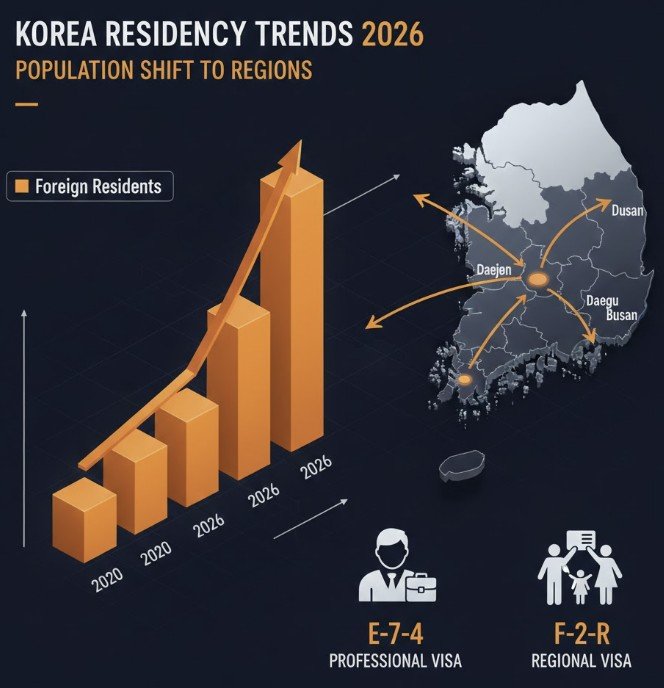
1. The Era of 1.7 Million Residents: 8.4% Rapid Growth
As of May 2025, the number of foreign residents aged 15 and older reached approximately 1.69 million, an 8.4% increase from the previous year. This stands in stark contrast to South Korea’s overall population decline, proving that foreign talent has become an indispensable pillar of the Korean economy.
- Growth Drivers: The surge is most prominent in Employment Visas (E-9, E-7) and Study Visas (D-2).
- The “Settlement” Shift: We are seeing a higher proportion of “Registered Foreigners” rather than short-term visitors, indicating a growing desire for long-term integration into Korean society.
2. The Rise of F-2-R: Seeking Residency Outside Seoul
The most striking trend is the expansion of the Region-Specific Visa (F-2-R). For 2025-2026, the government designated 107 cities and counties as target regions, allocating a massive quota of 5,072 slots in 2025 alone.
Comparison: F-2-R Expansion (2024 vs. 2026)
| Feature | 2024 (Pilot Phase) | 2025–2026 (Expansion) | The Shift |
| Target Regions | 89 Depopulated Areas | 107 Regions (incl. “Areas of Concern”) | Expansion to almost all non-metropolitan areas |
| Quota | Approx. 1,500 | 5,072 Persons | 3.3x Increase |
| Selection Method | Central Contest | Local Gov. Autonomous Selection | Higher importance on matching with regional firms |
Key Insight: As visa hurdles in Seoul and Gyeonggi-do heighten, talent is migrating to the Chungcheong, Gyeongsang, and Jeolla provinces. “Areas of Concern” near major cities like Daejeon and Daegu are emerging as the new preferred settlement sites.
3. E-7-4 Skilled Workers: 35,000 Annual Opportunities
The annual quota for the Skilled Worker Visa (E-7-4), which used to be limited to 1,000–2,000 people, is being maintained at 35,000 in 2026.
- Nationality Trends: Cambodia, Nepal (approx. 47k each), and Vietnam (39k) lead the transition from E-9 to E-7-4.
- The “R” Advantage: The introduction of the Region-Specific Skilled Worker (E-7-4R) has resulted in a 1.5x higher success rate for those working in “root industries” located in regional areas compared to general companies.
4. Data-Driven Conclusion: “Drop the Seoul Obsession”
The data for 2026 provides a clear strategy for anyone seeking a long-term future in Korea:
- Regional Areas are “Blue Oceans”: The F-2-R and E-7-4R quotas are concentrated in local municipalities. If you want permanent residency or a residence visa, target excellent companies in regional areas.
- Family-Friendly Opportunities: Regional settlement visas offer better perks for family accompaniment, such as work permits for spouses. Statistical data shows a shift from “earning money alone” to “improving quality of life with family.”
- Language Proficiency as the Filter: As quotas increase, the government is using Korean Language Proficiency (KIIP) as the primary filter. Completion of KIIP Level 3 or higher is now directly correlated with visa success rates.
Official Sources & References
- Korea Immigration Service (MOJ): Monthly Statistics on Immigration and Foreign Policy (Dec 2025/Jan 2026).
- Statistics Korea: 2025 Survey on Immigrants’ Living Conditions and Labour Force.
- Ministry of Justice: Operational Plan for the 2025-2026 Region-Specific Visa Program.