[Expert Commentary] On March 10, 2026, the South Korean government released a comprehensive report on the lives and employment of foreign residents. With the foreign population reaching a historic high, understanding these trends is no longer optional—it is essential for anyone building a career or life in Korea. Here is the definitive breakdown of the 2026 landscape.
1. The Big Picture: A Historic Milestone
As of May 2025 (reported in March 2026), the number of foreign residents aged 15 and older in South Korea has reached 1,692,000. This marks a significant increase of 132,000 people (8.4%) compared to the previous year.
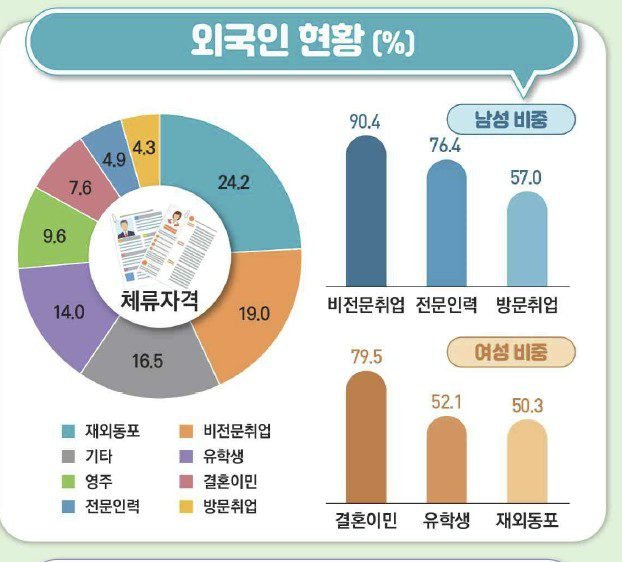
The Top 4 Visa Categories (by Population):
- Overseas Koreans (F-4): 24.2%
- Non-professional Employment (E-9): 19.0%
- International Students (D-2, D-4): 14.0%
- Permanent Residency (F-5): 9.6%
2. Rising Stars vs. Fading Paths: Growth Trends
The data reveals a clear shift in the types of people moving to South Korea.
- Students (D-2/D-4): Saw the largest growth with an increase of 36,000 people year-over-year.
- Permanent Residents (F-5): Increased by 21,000, reflecting a stronger trend toward long-term settlement.
- Professional Talent (E-1~E-7): Grew by 17,000, showing a 25.3% jump in specialized manpower.
- Working Visit (H-2): Experienced a decrease of 10,000 people, as many shift to other residency types.
3. Where Do People Live? The “Metropolitan” Concentration
The “Go Local” initiative is gaining traction, but the Seoul Metropolitan Area (Seoul, Incheon, Gyeonggi) remains the primary hub.
- Capital Area Residents: 57.5% of all foreign residents live in the metropolitan area.
- Regional Concentration: Certain visas are heavily concentrated in the capital region, specifically Working Visit (H-2) at 81.0% and Permanent Residency (F-5) at 77.5%.
- Student Hubs: While many live in Gyeonggi, Seoul (28.1%) remains the most popular city for international students.
4. Employment and Participation
The Korean labor market remains highly dependent on foreign talent, with professional and non-professional sectors showing nearly full employment.
- Employment Rates: Non-professional (E-9) and Professional (E-1~E-7) sectors both report employment rates exceeding 99%.
- Industry Focus: 44.9% of foreign workers are engaged in the Mining and Manufacturing sector.
- Satisfaction: Interestingly, Non-professional workers (E-9) reported the highest job satisfaction rate at 77.0%.
Conclusion: A Roadmap for the Future
This 2026 data proves that South Korea is rapidly transforming into a multi-cultural professional hub. Whether you are a student looking to transition to a work visa or a professional aiming for permanent residency, the numbers show that the pathways are expanding.
Official Sources & References
- Ministry of Justice & Statistics Korea: 2025 Survey on Immigrants’ Living Conditions and Labour Force (Published March 2026).
- Official Portal: HiKorea (www.hikorea.go.kr)