Understanding the shifting landscape of foreign residency in South Korea is crucial for both individuals and policymakers. Based on the latest joint report from the Ministry of Justice and Statistics Korea (March 2026), this Master Report synthesizes four critical areas: population growth, economic success, living challenges, and job satisfaction. Explore the data that defines expat life in Korea today.
1. The 1.69 Million Era: A Strategic Shift in Population
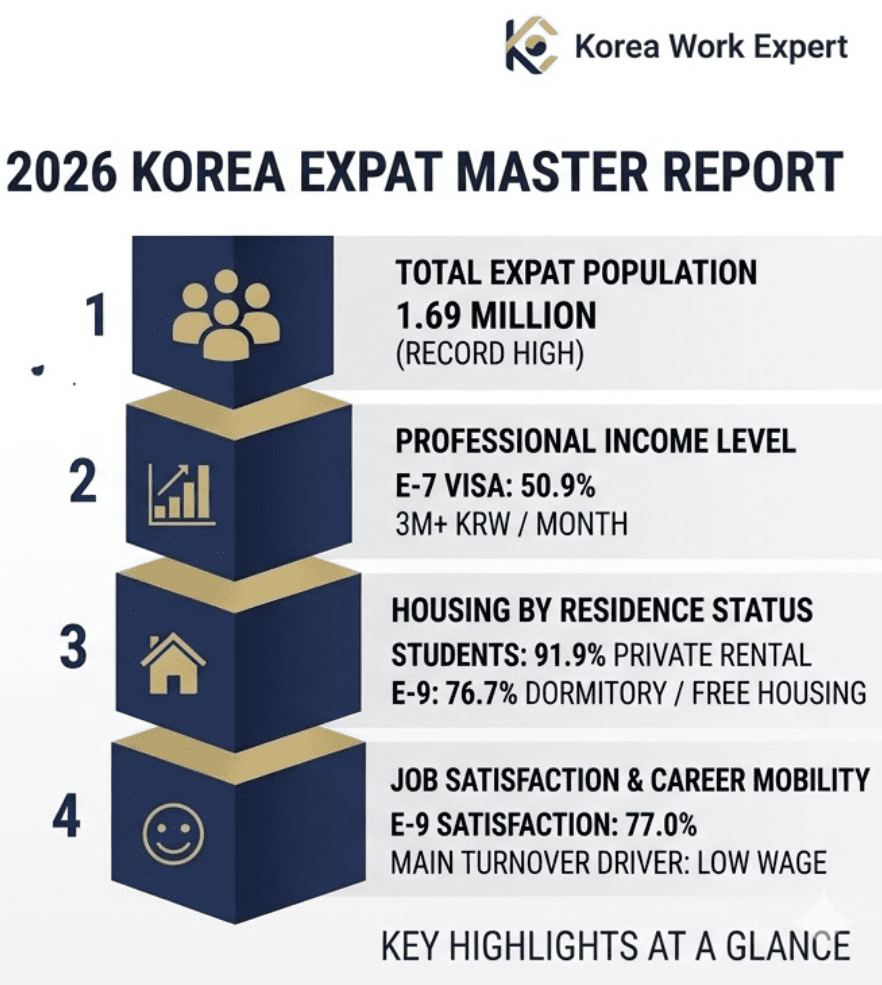
The foreign resident population in South Korea (aged 15+) has hit a historic milestone of 1.69 million, an 8.4% increase from the previous year.
- Key Insight: Korea is no longer just a destination for temporary labor; it is becoming a hub for long-term settlement.
- Growth Leaders: International students (+36,000) and Permanent Residents (+21,000) showed the most significant growth.
- Declining Path: The Working Visit (H-2) category decreased by 10,000, signaling a transition toward more specialized visa types.
🔗 [Read More: Detailed 2026 Population & Visa Distribution Analysis]
2. The Economic Success Formula: Education & Income
Data proves a direct correlation between high education levels and financial success within the expat community.
- The 3 Million KRW Club: 50.9% of Professional Manpower (E-1~E-7) and 48.0% of Permanent Residents (F-5) earn more than 3 million KRW monthly.
- Education as an Asset: Specialized professionals boast the highest rate of university graduates at 53.7%.
- Strategic Spending: While students spend 52.6% of their income on living costs, E-9 workers prioritize their future by sending 56.5% of their earnings home.
🔗 [Read More: How Professionals are Leading Income Trends in 2026]
3. The Reality of Settlement: Housing & Hardships
Residency type dictates the quality of daily life, with a clear divide in housing and financial stability.
- Housing Patterns: 91.9% of international students navigate the private rental market, while 76.7% of E-9 workers utilize employer-provided housing.
- Financial Pressure: Students are the most economically vulnerable, with 22.0% reporting hardships, primarily due to tuition and high utility bills.
- Healthcare Gap: Medical expenses remain a significant burden, preventing 36.2% of those in financial trouble from seeking necessary treatment.
🔗 [Read More: Navigating the Housing and Economic Reality of Expat Life]
4. The Workplace Pulse: Satisfaction & Mobility
Job satisfaction varies greatly by visa type, with interesting patterns in how workers view their careers in Korea.
- The Satisfaction Paradox: Non-professional (E-9) workers report the highest job satisfaction at 77.0%, largely due to stable wages and hours.
- The Drive for More: Despite high satisfaction, 10.8% of workers seek a job change, with “Low Wages” being the primary motivator across all sectors.
- Networking vs. Digital: While E-9 workers rely entirely on personal networks for new jobs, Professionals and Students are digital-first, with over 50% using online platforms.
🔗 [Read More: Deep Dive into Job Satisfaction and Career Transitions]
Conclusion: Navigating Your Future with Data
The 2026 landscape shows a Korea that is more open yet more competitive. Success is increasingly tied to technical skills, language proficiency, and strategic financial management. Use these insights to map your own journey toward a successful life in South Korea.