Acquiring the Skilled Worker (E-7-4) visa is a formal acknowledgment that you are a vital “Expert” in South Korean society. However, this is not the destination—it is a new beginning. For many skilled professionals, the first priority after a visa change is to live with their families in Korea and, ultimately, secure Permanent Residency (F-5).
Based on the January 2026 Immigration Manual and December 2025 statistics, we provide a strategic roadmap for a “better life” in Korea after securing your E-7-4 status.
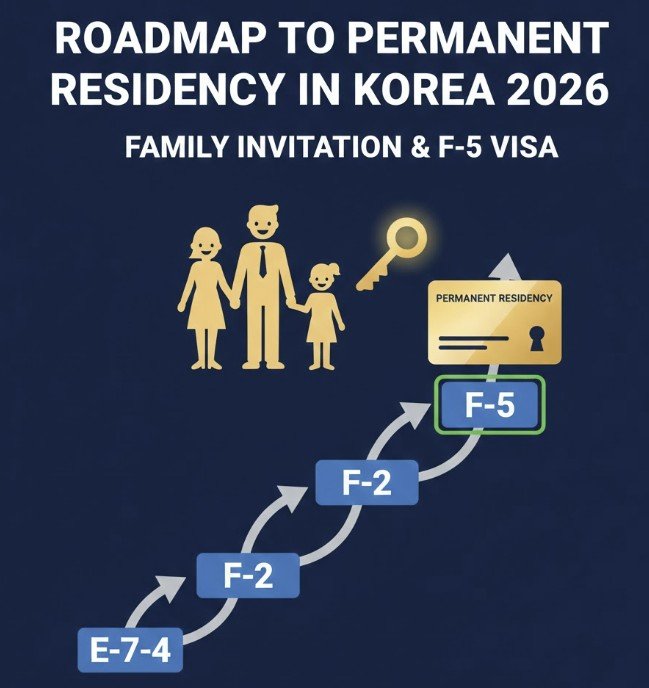
1. Living with Family: Strategic Invitation of Dependents (F-3)
One of the most significant benefits of the E-7-4 visa is the eligibility to invite your spouse and minor children to live with you in South Korea.
Income and Housing Requirements
To ensure that families can settle stably, the South Korean government evaluates the inviter’s financial capacity and living environment.
- Income Standard: According to the 2026 manual, you may need to prove an annual income of 80% to 100% of the previous year’s GNI (Gross National Income), depending on the number of family members.
- Housing Requirement: You must secure an appropriate residence (Jeonse or Wolse) and submit a valid lease agreement to prove a suitable living space for your family.
- Spouse’s Economic Activity: While F-3 visa holders are generally restricted from working, they may apply for “Activities Beyond Status” permits under specific conditions. The government is gradually relaxing these rules to support the integration of skilled workers’ families.
2. Moving Towards Greater Freedom: The F-2 Residency Visa
After working diligently under an E-7-4 status for a certain period (usually 5 years or more) while increasing your income and Korean language level, the next logical step is the Residency (F-2-99) visa.
Advantages of the F-2 Visa
- Freedom of Employment: The greatest benefit is the freedom to change jobs. You are no longer tied to a specific employer and can freely transition between companies or engage in various economic activities.
- Key Preparation: Consistently maintaining an income above the GNI and completing KIIP Stage 5 are essential. Statistics from December 2025 show a steady increase in F-2 holders, proving that many skilled workers are successfully settling long-term.
3. The Final Destination: Permanent Residency (F-5)
The ultimate stage of life in South Korea is obtaining Permanent Residency (F-5). As a permanent resident, you are free from visa renewal hassles and enjoy social benefits nearly identical to those of Korean citizens.
Core Requirements in 2026
- High Income: Generally, a stable income of at least 2x the GNI is required.
- Language and Integration: A deep understanding of Korean society, typically proven by passing the KIIP Comprehensive Test, is mandatory.
- 2026 Policy Trend: The government is reasonably adjusting the threshold for long-term skilled workers who have contributed to industrial sites, making the path to F-5 more accessible than in the past.
4. Essential Maintenance: The “Duty to Report”
A small administrative mistake can jeopardize years of effort. You must strictly adhere to reporting obligations:
- Change of Residence: If you move, you must report your new address to the local immigration office or community center within 15 days.
- Passport Renewal: If you receive a new passport, this must also be reported within 15 days.
- Why it matters: Fines for reporting violations are heavily checked as part of the “Law-Abiding” evaluation during F-2 or F-5 screenings.
5. Conclusion: From Skilled Worker to Valued Neighbor
The E-7-4 visa is the starting point for being recognized as a true member of the Korean community. By utilizing government settlement support, maintaining your income, and continuing your Korean language studies, building a happy future with your family is no longer just a dream.
Official Sources & References
- Korea Immigration Service (MOJ): Guidelines for Change of Status to Residency and Permanent Residency, January 2026.
- Ministry of Justice: Visa Issuance Manual for Family Invitations, January 2026.
- Statistics Korea: Monthly Statistics on Long-term Foreign Residents by Status, December 2025.
- HiKorea Official Portal: Online Reservation for Family Invitation and F-5 Applications (www.hikorea.go.kr).