South Korea is renowned for its world-class medical system, and at its heart lies the National Health Insurance (NHI). For any foreigner staying in Korea for more than 6 months, enrollment is not an option—it is a legal requirement.
As of January 2026, the government has updated its premium calculation methods and strengthened the link between insurance payments and visa extensions. This guide breaks down everything you need to know about navigating the NHI to ensure your health and your legal status remain secure.
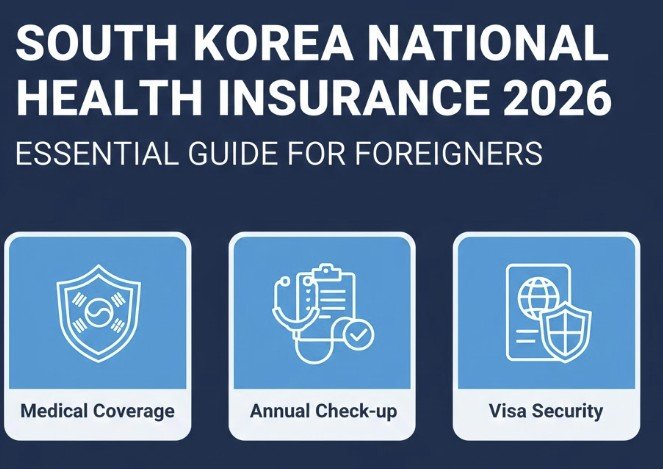
1. Who Must Enroll? Understanding Mandatory Enrollment
According to the 2026 government directives, foreigners meeting the following criteria are automatically or mandatorily enrolled in the NHI.
- Employee Subscribers (직장가입자): If you are hired by a company under a professional work visa (e.g., E-7, E-1), your employer handles the enrollment. The premium is split 50/50 between the company and the employee.
- Local Subscribers (지역가입자): International students (D-2), job seekers (D-10), or freelancers who have stayed in Korea for 6 months or more are classified as local subscribers. In this case, you are responsible for paying the full premium amount.
2. 2026 Premium Rates: How Much Will You Pay?
Premiums are adjusted annually by the Ministry of Health and Welfare. For local subscribers, the premium is calculated based on income and assets, but for foreigners, there is a “Minimum Premium” rule.
- Standard Rule: Foreigners must pay at least the average premium of all subscribers from the previous year. As of January 2026, this typically amounts to approximately ₩150,000–₩160,000 per month.
- International Student Discount (D-2): To ease the financial burden on students, those enrolled in degree programs (D-2) receive a reduction of approximately 50% or more, making their monthly premium significantly lower.
- Payment Methods: You can pay via monthly GIRO invoices, automatic bank transfer, or virtual accounts by the end of each month.
3. Top 3 Benefits of the National Health Insurance
While the monthly cost may feel like a burden, the benefits are exceptionally strong, covering a wide range of medical needs.
- Massive Discounts on Medical Bills: The NHI covers 30% to 70% of total medical costs for everything from common colds to major surgeries. (Note: Local clinics are generally cheaper than large university hospitals).
- Free Health Check-ups: Every two years, the government provides a free comprehensive health screening. If you were born in an even-numbered year, you are eligible in 2026.
- Dental and Oriental Medicine: Scalings (once a year), cavity treatments, and acupuncture are all partially covered by the NHI, making specialized care affordable.
4. The Critical Link: Insurance Payments and Your Visa
This is the most important part of the 2026 policy. The South Korean government now strictly monitors insurance payment history during visa extension reviews.
- Penalty for Delinquency: If you miss even a single payment, you will not only lose your insurance benefits at hospitals but also face restrictions on your visa extension. Extensions may be limited to less than 6 months, or in severe cases, denied entirely.
- Address Change Risks: If you move and fail to report your new address within 14 days, you may not receive your invoices. The government considers this “the individual’s responsibility,” and any resulting late fees can jeopardize your stay. Always update your address on HiKorea!
5. Conclusion: NHI is Your “Safety Belt” in Korea
Statistics from December 2025 show that the satisfaction rate of foreigners with the Korean medical system is at an all-time high, primarily due to the accessibility provided by the NHI. Rather than viewing the premium as a tax, think of it as a premium ticket to some of the world’s best medical services at a fraction of the cost. Stay healthy, and stay compliant.
Official Sources & References
- National Health Insurance Service (NHIS): 2026 Guide to NHI for Foreigners and Overseas Koreans.
- Ministry of Justice (MOJ): January 2026 Manual on Visa Restrictions for Insurance Delinquents.
- Ministry of Health and Welfare: 2025 Statistical Yearbook of Health and Welfare, published 2026.
- HiKorea Official Portal: Information on Mandatory Health Insurance for Foreign Residents.