For dedicated professionals working in South Korea, transitioning to the K-point E74 (Skilled Worker) visa is more than just a legal change—it is a formal validation of your professional value. The South Korean government utilizes a rigorous scoring system to assess a worker’s proficiency, focusing on four foundational pillars: Income, Experience, Education, and Age.
To secure your future and reach the required 200-point threshold (out of a 300-point maximum), you must strategically optimize these basic categories. Based on the latest January 2026 Immigration Manual, this guide provides a deep dive into mastering the basic scoring items for your professional advancement.
“Before diving into the scoring system, make sure you meet the basic eligibility. If you haven’t read it yet, start with [Part 1: Mandatory Requirements & Selection System].”
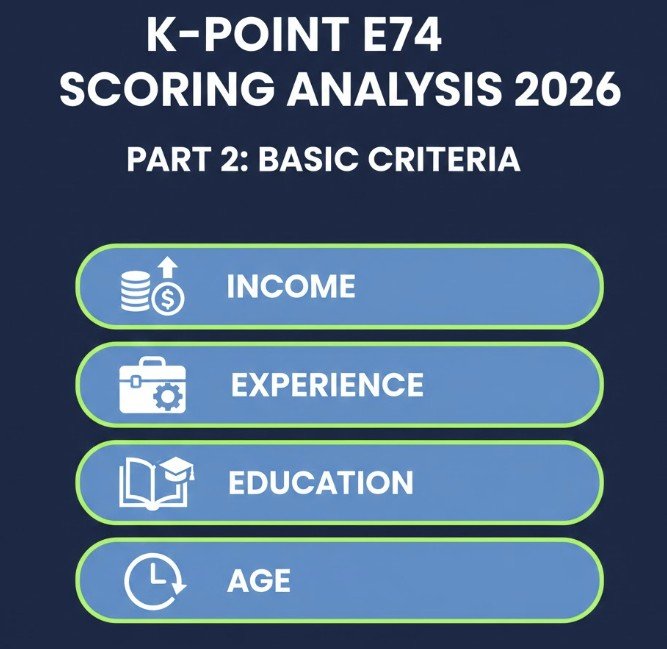
1. Annual Income: The Strongest Indicator of Professionalism
In the eyes of the South Korean government, your Annual Income is the most definitive proof of your expertise. A high salary indicates that you are an indispensable asset to your company, possessing skills that are difficult to replace.
How Income is Evaluated in 2026
- The Baseline: Points are awarded based on your average annual income over the past two years.
- Official Documentation: The government does not rely solely on your employment contract. Instead, they require the “Certificate of Income Amount” (소득금액증명) issued by the National Tax Service.
- Scoring Weight: Income is the “king” of the scoring table. In the 2026 manual, this category can account for up to 100 points or more, making it the fastest way to bridge the gap to 200 points.
Strategic Tip: Ensure that all your bonuses, overtime pay, and night-shift allowances are accurately reported and reflected in your tax statements. Discrepancies between your contract and your actual tax records can lead to point deductions.
2. Professional Experience: The Value of Loyalty and Skill
The K-point E74 system rewards consistency. It’s not just about how long you’ve been in Korea, but how much you’ve refined your craft within a specific industry or company.
The “Loyalty” Advantage
The government places a high premium on workers who remain with a single employer for an extended period.
- Continuous Employment: Longevity at your current workplace is rewarded with significant bonus points.
- Success Trends: According to December 2025 statistics, a vast majority of successful E-7-4 applicants have served at their current workplace for at least 3 years.
Strategic Tip: Avoid frequent job changes if you are nearing your E-7-4 application window. Building trust with your current CEO not only boosts your “Experience” points but is also crucial for securing the mandatory Employer Recommendation Letter.
3. Education and Age: Foundations for Long-term Contribution
These categories evaluate your potential to contribute to Korean society over the coming decades.
Education (Academic Credentials)
While all degrees are valued, the South Korean government specifically incentivizes local education.
- The “Korea Advantage”: An Associate, Bachelor’s, or Master’s degree obtained from a South Korean university yields significantly higher points than an equivalent degree from overseas.
- 2025 Trend: There is a notable increase in “Global Talent” who started as international students (D-2) and transitioned into the skilled labor force, leveraging their local degrees to bypass high experience requirements.
Age (The Youth vs. Wisdom Balance)
The scoring system is designed to balance “youthful energy” with “technical wisdom.”
- Points by Age: Generally, applicants in their 20s and early 30s receive the highest points in the age category.
- The Veteran’s Path: If you are an older professional, do not be discouraged. The system is designed so that a lower age score can be easily offset by higher scores in the Income and Experience categories.
4. Practical Compliance: 2026 Practical Points for Success
The 2026 manual emphasizes “Consistency and Credibility.” Even a high-scoring profile can be rejected if the documentation is flawed.
- Document Alignment: Your “Certificate of Income Amount” must match your “Employment Contract” perfectly. Any unverified income will be disregarded.
- Authentication: All foreign educational certificates must undergo Apostille certification or Consular verification to be recognized.
- The KIIP Synergy: Data from December 2025 shows that a record number of applicants are completing the Social Integration Program (KIIP). Why? Because the points gained from Korean language proficiency often act as the “safety net” for those who are slightly short on basic items like Income or Age.
5. Comparison Table: Basic Scoring Overview (2026)
| Category | Key Metric | Max Points (Approx) | Critical Document |
| Income | 2-Year Avg Salary | 100+ | Tax Office Income Certificate |
| Experience | Continuous Service | 50+ | Career Certificate / 4 Insurances |
| Education | Highest Degree | 30-50 | Degree (Apostille/Local) |
| Age | Date of Birth | 20-30 | Passport / ARC |
Conclusion: A Strong Foundation Leads to Guaranteed Results
The basic items of the K-point E74 are essentially a numerical translation of the hard work and sweat you have invested in South Korea. Success in professional advancement does not happen overnight; it requires meticulous management of your income and career path.
Use the 2026 manual to conduct a “cold-blooded” diagnosis of your current points. If you find yourself 10 or 20 points short, identify whether you can boost your income or if you need to focus on the “Additional Points” categories, which we will cover in Part 3 of this series.
Official Sources & References
- Korea Immigration Service (MOJ): Skilled Worker Points System (K-point E74) Detailed Scoring Table, January 2026.
- Ministry of Justice: Visa Issuance and Management Guidelines, January 2026.
- HiKorea Official Portal: K-point E74 Self-Diagnosis Service & Public Notices (www.hikorea.go.kr).
- Statistics Korea: Monthly Statistics on Foreign Residents (Income and Education Distribution), December 2025.