Graduating from a Korean university is a major achievement, but the transition to a professional career can be challenging. To support global talent, the South Korean government offers the D-10 (Job Seeker) visa. In 2026, significant updates have been made to provide more stability for job seekers, including extended stay periods and flexible internship rules.
However, the D-10 visa is not just a simple extension of your stay; it is a point-based system that requires careful planning and strict adherence to administrative rules. Based on the January 2026 Immigration Manual, here is everything you need to know to successfully navigate your D-10 journey.
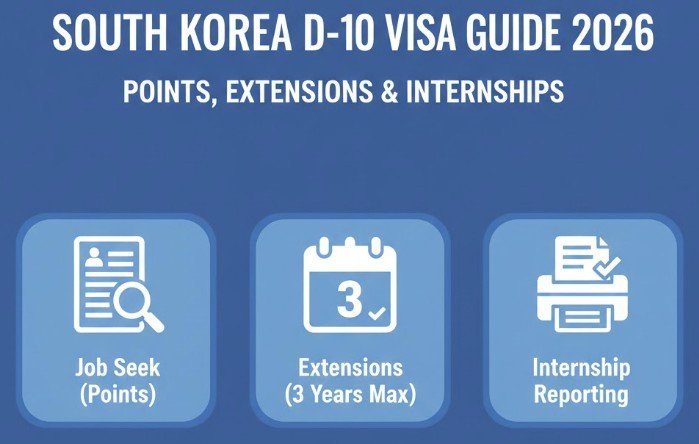
1. The D-10 Points System: Crossing the 60-Point Threshold
The D-10 visa operates on a “Points-Based Job Search” system. To qualify, you must score at least 60 points out of a total of 190. Crucially, you must obtain at least 20 points from the “Basic Criteria” to even be eligible for application.
① Basic Criteria (Max 50 Points)
- Age: Points are awarded based on age groups between 18 and 39. Applicants aged 20–24 often receive higher points to encourage early-career talent.
- Academic Background: Points vary by degree level (Associate, Bachelor’s, Master’s, PhD). Graduates from Korean universities receive additional bonus points compared to those from overseas institutions.
② Optional Criteria (Max 110 Points)
- Work Experience: Relevant professional experience within the last 10 years (E-1 to E-7 fields).
- Study in Korea: Having a degree from a Korean university within the last 3 years provides a significant boost.
- Korean Language Proficiency: Scores from TOPIK or completion levels of the Social Integration Program (KIIP) are vital. With over 90,000 KIIP participants in late 2025, language skills are no longer optional—they are a core requirement.
③ Additional Bonus & Deduction Points
- Bonus: Recommendations from central government agencies or graduating from a World Top 200 University.
- Deduction: Previous violations of the Immigration Control Act will result in point deductions based on the frequency and severity of the fines.
2. Extending Your Stay: Proving “Sincere” Job Search Efforts
As of late 2025/early 2026, the maximum stay duration for D-10 has been extended to 3 years (previously 2 years). However, extensions are typically granted in 6-month or 1-year increments, and the immigration office strictly evaluates your job-seeking activities.
Required Documents for Extension
- Job Search Activity Plan: A detailed outline of your past activities and future plans.
- Proof of Job Search Activities: You must provide objective evidence, such as:
- Job application confirmation emails.
- Interview invitation texts or emails.
- Participation certificates from job fairs.
- Financial Proof: A bank balance certificate (usually around ₩3M–₩5M) to prove you can support yourself without illegal work.
Pro-Tip: If the immigration office deems your job-seeking efforts insufficient, they may deny your extension and order you to leave the country. Always keep a digital folder of every application you send.
3. Mandatory Rules for Internship Activities
Many D-10 holders engage in internships to gain experience. However, treating an internship like a casual part-time job (Albait) without reporting it can lead to visa cancellation.
① The Duty to Report Internships
According to the 2026 guidelines, you must report your internship to the local immigration office within 15 days of starting.
- Allowed Fields: The role must fall under professional categories (E-1 to E-7). Simple labor (serving, delivery, etc.) is strictly prohibited.
- New 2026 Rule: You can now intern at a single company for up to 1 year (previously 6 months), and there is no longer a limit on the total cumulative internship period within your D-10 stay.
- Reporting Method: Currently, reporting is often done via fax (1577-1346) or in person. Always call 1345 to verify the latest submission method.
② Illegal Employment vs. Legitimate Internship
Working at a restaurant, convenience store, or construction site on a D-10 visa is considered “Illegal Employment.” If caught, you will face high fines, and your future chances of changing to a professional visa (E-7) may be permanently blocked.
4. Expert Advice for the 2026 Job Seeker
The success rate of D-10 holders transitioning to professional status is rising as the government streamlines administrative procedures.
- Calculate Your Points Early: Use the self-diagnosis tools on HiKorea to ensure you meet the 60-point requirement before your D-2 visa expires.
- Level Up Your KIIP: Use your job-seeking period as a “Golden Time” to complete higher levels of the Social Integration Program. This will be invaluable for your future F-2 or F-5 visa applications.
- Manage Administrative Risks: Failing to report a change of address within 15 days results in a fine that can hinder your visa extension. Stay compliant to stay safe.
Official Sources & References
- Korea Immigration Service (MOJ): Job Seeker (D-10) Points System and Internship Guidelines, January 2026.
- Ministry of Justice: Criteria for D-10 Visa Issuance and Extension, January 2026.
- Statistics Korea: Monthly Report on Foreign Job Seekers and International Students, December 2025.
- HiKorea Official Portal: D-10 Self-Diagnosis and Electronic Petitions (www.hikorea.go.kr).