[Expert Commentary]
Success in South Korea is often measured by stability and growth. According to the latest 2026 government report, professional talent (E-1 to E-7) and permanent residents (F-5) are leading the expat community in both income and education. If you are aiming for the top tier of residency, these numbers represent your future roadmap.

1. The 3 Million KRW Milestone: Who Reaches the Top?
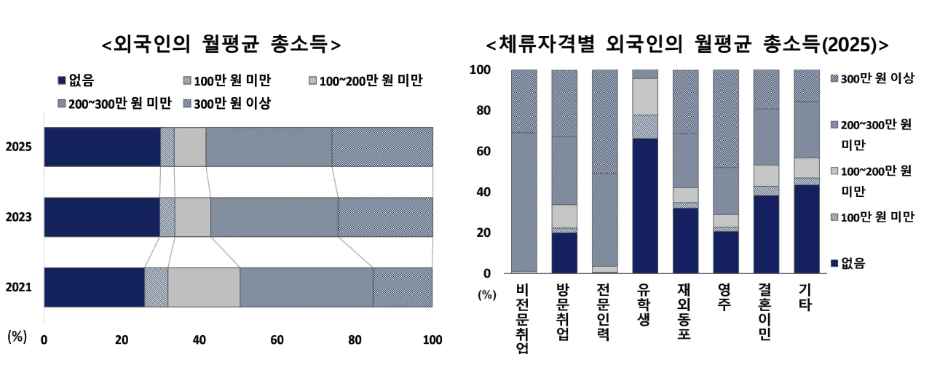
Income is a primary indicator of visa success. The data shows a clear divide between professional/permanent residents and other visa types.
- High Earners: Over half of the professional manpower (50.9%) and nearly half of the permanent residents (48.0%) earn a monthly total income of 3 million KRW or more.
- The Stability Gap: In contrast, only 4.2% of international students reach this income bracket, highlighting the significant financial jump after transitioning to a professional visa.
- Spending Habits: Professional workers prioritize remittances (36.1%) significantly more than other groups, showing their role as strong economic contributors to their home countries.
2. Education: The Engine of Residency Success
Why do E-7 and F-5 holders earn more? The 2026 report points to a direct correlation with educational background.
- Academic Excellence: Professional manpower (E-1~E-7) boasts the highest percentage of university graduates or higher at 53.7%.
- Pathway to F-5: Permanent residents also show a high academic profile, with 70.1% having a high school degree or higher, which often serves as a prerequisite for points-based residency systems.
- Insight: Investing in your education—whether it’s a Korean degree or specialized technical certification—is the most reliable way to secure a high-income visa status.
3. Quality of Life and Job Satisfaction
Higher income and better education lead to a more stable life in South Korea.
- Overall Satisfaction: Professional workers report a high overall job satisfaction rate of 74.7%, significantly outperforming groups like international students (61.2%) or working visit (H-2) holders (58.7%).
- Financial Resilience: Only 6.7% of professional workers reported experiencing economic difficulties in the past year, the lowest among all visa categories.
- Housing Advantage: Permanent residents (F-5) have the highest homeownership rate among expats at 39.8%, signaling a deep and successful integration into Korean society.
Conclusion: Strategic Career Growth
The 2026 data confirms that the “Professional Path” is the most rewarding route for expats in Korea. High education leads to specialized visas, which in turn leads to higher income and long-term residency stability.
Official Sources & References
- Ministry of Justice & Statistics Korea: 2025 Survey on Immigrants’ Living Conditions and Labour Force (Published March 2026).
more information about TOPIK vs KIIP (below)