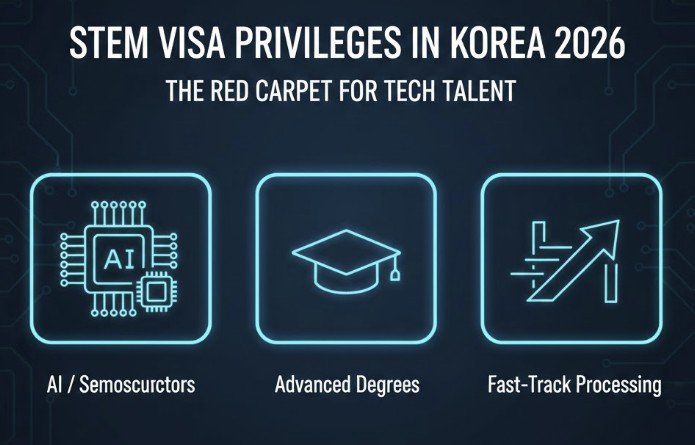
South Korea is rapidly strengthening its national competitiveness by focusing on 12 strategic technologies, including Artificial Intelligence (AI), Semiconductors, and Secondary Batteries. To fuel this innovation, the South Korean government provides extraordinary visa privileges for international graduates in STEM (Science, Technology, Engineering, and Mathematics) fields.
Unlike general degree holders, STEM experts are treated as “High-Value Talent,” receiving exclusive benefits that simplify their path to residency and employment. Based on the January 2026 Immigration Manual and December 2025 statistics, let’s analyze the unique advantages available only to STEM professionals.
1. The Fast Track: K-STAR (F-2-T) Residency Visa
The most powerful benefit for STEM Master’s and PhD holders is the newly established K-STAR (F-2-T) visa. This revolutionary pathway allows elite talent to bypass the standard professional work visa (E-7) and jump directly to Residency (F-2) status.
Key Advantages of K-STAR
- Academic Exemptions: Graduates from top-tier global universities (QS rankings, etc.) or prestigious Korean STEM programs can apply for this visa through recommendations from relevant ministries (e.g., Ministry of Science and ICT), even if they haven’t met certain income thresholds yet.
- Income-Based Fast Track: According to 2026 guidelines, individuals in high-tech sectors with an expected annual income of 3x the GNI (Gross National Income) enjoy drastically relaxed requirements for work experience.
- Pathway to Permanent Residency (F-5): Holders of the F-2-T visa can apply for Permanent Residency (F-5) after just 3 years of stay, provided they meet specific criteria. This is one of the fastest settlement routes in the world.
2. Relaxed “Major-to-Job” Correlation for E-7 Visas
One of the biggest hurdles for general graduates is proving that their major exactly matches their job description. However, STEM graduates benefit from highly flexible criteria.
- Convergence Roles Allowed: Since high-tech fields often involve interdisciplinary work, the government allows STEM graduates to change to an E-7 visa even if the job isn’t a 100% match to their major, as long as a technical correlation can be established.
- Experience Requirement Exemption: While overseas graduates may need years of experience for certain roles, STEM graduates from Korean universities (Bachelor’s or higher) are exempt from experience requirements, allowing them to start working immediately after graduation.
3. Exemption from the 20% Local Hiring Quota
The “20% Foreigner Quota” (limiting foreign staff to 20% of the local workforce) is a major obstacle for many Korean companies. For STEM talent, this barrier is significantly lowered or removed.
- 50% Expanded Quota: Companies in advanced industries that receive employment recommendations from the Ministry of Trade, Industry and Energy (MOTIE) or KOTRA can expand their foreigner hiring limit to 50% of their local workforce.
- GKS Scholar Privilege: STEM graduates who were Global Korea Scholarship (GKS/D-2-7) recipients are completely exempt from the local hiring ratio. This means even a small tech startup with only a few employees can hire you without any legal restrictions.
4. Extended Job Seeking (D-10) and Internship Benefits
STEM graduates receive more stable support even while searching for a job.
- Flexible Extensions: High-tech degree holders enjoy more lenient scrutiny during D-10 visa extensions, provided they show sincere job-seeking efforts.
- Simplified Internship Reporting: The government has streamlined the internship reporting process for STEM talent to encourage practical field experience before transitioning to a full work visa.
5. Conclusion: Your Technical Expertise is Your Legal Status
In 2026, South Korea’s visa system is becoming increasingly “Tech-Friendly” to welcome global STEM innovators. Your specialized knowledge and technical skills are more than just tools for employment; they are your “Golden Ticket” to becoming a highly respected member of Korean society.
The latest government directives are designed to ensure that elite talent like you can focus entirely on innovation without being hindered by administrative red tape. Check the 2026 Manual to see which specific exemptions apply to your field and start your journey as a recognized expert in Korea today.
Official Sources & References
- Korea Immigration Service (MOJ): Visa Issuance Manual for Top Talent and High-tech Sectors, January 2026.
- Ministry of Justice: Guidelines for Residency Change for International Students and STEM Professionals, January 2026.
- Statistics Korea: Monthly Statistics on Professional Talent and High-tech Visa Holders, December 2025.
- HiKorea Official Portal: Information on K-STAR Visas and High-tech Employment Recommendations (www.hikorea.go.kr).