Introduction
To legally work in South Korea, you must obtain a specific Residence Status (Visa) that matches your professional activities, whether you are a high-tech expert, a skilled worker, or an investor. Based on the 2026 South Korea Immigration Management Manual, the government has expanded opportunities for global talent to support national competitiveness. This guide breaks down every major work visa type to help you find your path.
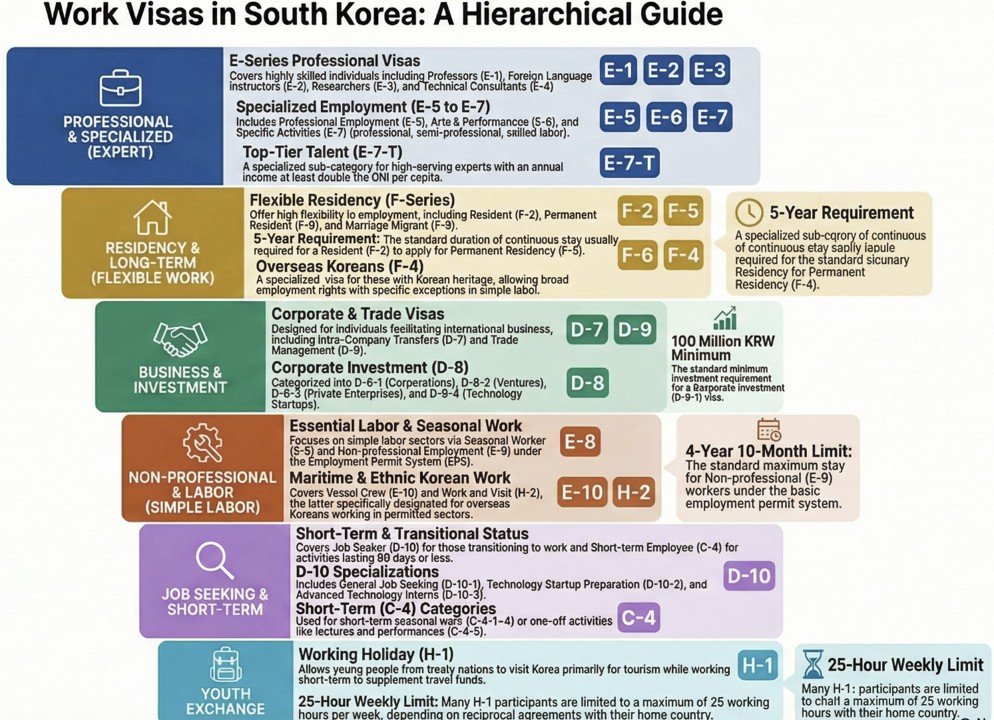
1. Professional Employment Visas (E-1 to E-7)
Professional visas are for individuals with specialized knowledge or skills. These are the most common paths for “white-collar” experts.
| Visa | Title | Description & Target Audience | Max Stay (Per Entry) |
| E-1 | Professor | Education and research at higher education institutions. | 5 Years |
| E-2 | Foreign Language Instructor | Teaching conversation at academies or language centers. | 2 Years |
| E-3 | Research | Natural science or high-tech research at specialized institutes. | 5 Years |
| E-4 | Technical Instruction | Providing expertise in specialized industrial/scientific fields. | 5 Years |
| E-5 | Professional | Licensed experts (Lawyers, CPAs, Pilots, Doctors). | 5 Years |
| E-6 | Culture & Arts | Profit-making activities in music, arts, literature, and sports. | 2 Years |
| E-7 | Special Activities | 94 designated occupations (Managers, Professionals, Skilled Workers). | 3-5 Years |
Pro Tip: The E-7 Visa is subdivided into E-7-1 (Professionals), E-7-2 (Semi-professionals), and the highly sought-after E-7-4 (Skilled Workers). In 2026, new categories like E-7-S (Negative system for experts) and E-7-T (Top-Tier Talent) have been introduced to attract high-income professionals.
2. Non-Professional & Skilled Labor Visas (E-8 to E-10, H-2)
These visas cater to industries facing labor shortages, such as agriculture, manufacturing, and fisheries.
| Visa | Title | Scope & Features | Key Notes |
| E-8 | Seasonal Worker | Short-term labor for farming and fishing seasons. | Max 8 Months |
| E-9 | Non-Professional | Manufacturing, construction, and agriculture via EPS system. | Max 4yr 10mo |
| E-10 | Vessel Crew | Crew members on coastal or fishing vessels. | Max 4yr 10mo |
| H-2 | Working Visit | Ethnic Koreans from China/CIS regions (Ages 18+). | 3 Years (Extendable) |
3. Business and Investment Visas (D-7 to D-9)
For those dispatched by foreign companies or individuals starting their own business.
- D-7 (Intra-company Transfer): For essential personnel dispatched to Korean branches or affiliates.
- D-8 (Corporate Investment): For managing foreign-invested companies or starting tech ventures. (Max 5 years)
- D-9 (Trade Management): For traders with a trade business code, or supervisors of equipment installation and shipbuilding.
4. Short-term Work & Job Seeking
- C-4 (Short-term Employment): For profit-making activities under 90 days (advertising, lectures, temporary research).
- D-10 (Job Seeking): For those seeking E-1 to E-7 jobs or preparing for tech startups. The D-10-1 (Point-based system) is a crucial bridge for graduates to find employment.
5. Residency and Long-term Settlement Visas (F-series)
The F-series visas offer the most freedom, allowing you to change jobs more easily and settle permanently.
- F-2 (Residency): Includes the F-2-7 (Point-based professional) and the F-2-R (Regional-specific) visas. These are the ultimate goals for long-term residents.
- F-4 (Overseas Korean): Extensive work rights for ethnic Koreans, excluding simple labor or gambling sectors.
- F-5 (Permanent Residency): The “Green Card” of Korea. Unlimited stay and no restrictions on employment.
- F-6 (Marriage Migrant): For spouses of Korean citizens. Full employment freedom.
6. Specialized Visa Programs (2025-2026 Updates)
To tackle population decline and attract global “Top-Tier” talent, Korea has launched innovative programs:
- Regional-Specific Visa (F-2-R): Issued on the condition of living and working in designated “population-declining areas.” Requires a local governor’s recommendation.
- K-STAR / Top-Tier Visa (F-2-T): A fast track for high-income STEM experts. If your income is 4x GNI, many career and education requirements are waived.
- Metropolitan-type Visa: A pilot project for international students or workers recommended by major metropolitan cities like Daejeon, Busan, or Chungbuk.
Important Compliance Notes
- The 14-Day Reporting Rule: You must report any changes in your residence, passport information, or employer within 14 days to the Immigration Office. Failure to comply leads to heavy fines and “compliance demerits” during your permanent residency (F-5) screening.
- Income Proof: For visa extensions or changes, the authorities check the “Certificate of Income Amount” issued by the National Tax Service, not just your employment contract.
Conclusion: Strategy Determines Settlement
South Korea in 2026 is more open than ever, but the requirements are stricter. Success depends on choosing the right visa and building a career roadmap toward residency.